Get Started
October 27, 2026
- Written By
Annie Asai
For years, the big question about alternative carriers was trust. Would they deliver on time? Would they still be around next year? Could a shipper put real volume on them?
Tusk's 2026 Alternative Carrier Benchmark Report, based on a survey of 600 U.S. shipping and logistics decision-makers, shows that question is fading. A different one is taking its place. Shippers are now asking how to manage several carriers without the work piling up.
In 2025, 54% of shippers named trust and reliability as their single biggest barrier to adopting alternative carriers. In 2026, that dropped to 43%.
Coverage concerns fell too. The share of shippers naming coverage as their biggest barrier went from 12% to 7%. Alternative carrier networks have grown, and shippers have noticed.
Trust is still the most-named barrier. But it no longer dominates the conversation the way it did a year ago.
As trust fell, tracking and visibility rose. The share of shippers naming it as their biggest barrier more than doubled, from 8% to 17%.
That shift makes sense. Shippers who have moved past "can I trust these carriers?" run into the day-to-day reality of using them. Every carrier has its own tracking portal. Claims get filed in different places, under different rules. Rate cards use different zone definitions, which makes it hard to compare costs side by side.
The report describes this as an infrastructure and operations problem, and one that can be solved.
One alternative carrier is manageable. The challenge comes when a shipper adds a second or third to cover more of the country or to keep options open.
Each new carrier can bring another integration, another invoice and another claims process. The customer service team has another place to look when a customer asks where an order is. Finance has another bill to reconcile. This is often where a promising carrier strategy stalls. The carriers perform well, but the overhead of running them keeps volume from growing past a pilot.
The report saw a version of this among shippers who haven't tried alternative carriers yet. Among those non-adopters, 40% said switching feels too risky to their operations. Their concern is the disruption of making the change, more than the carriers themselves.
Shippers were clear about what would make adoption easier. When asked what would need to be true beyond cost, 40% named seamless integration with their existing tech stack, and 36% named a centralized platform to manage multiple carriers.
The strongest signal came from a question asked two years running. When asked whether a platform that centralizes tracking, claims and rate management would make them more likely to adopt alternative carriers, 87% of shippers in 2026 said yes.
Whatever tools you use, a few habits keep a multi-carrier setup manageable.
Decide where tracking lives before you add a carrier. Your team and your customers should have one place to check an order, whichever carrier has it. We covered why tracking matters so much to the end customer earlier this year.
Standardize how claims get filed. Agree on one internal process for documenting damage and loss, so claims don't depend on who remembers each carrier's rules.
Compare costs in one view. Normalize rates and fees across carriers before you decide where to route volume. Base rates alone don't tell you the full cost.
Connect through the systems you already use. Adding carriers through your existing TMS or WMS keeps your warehouse team working in one place.
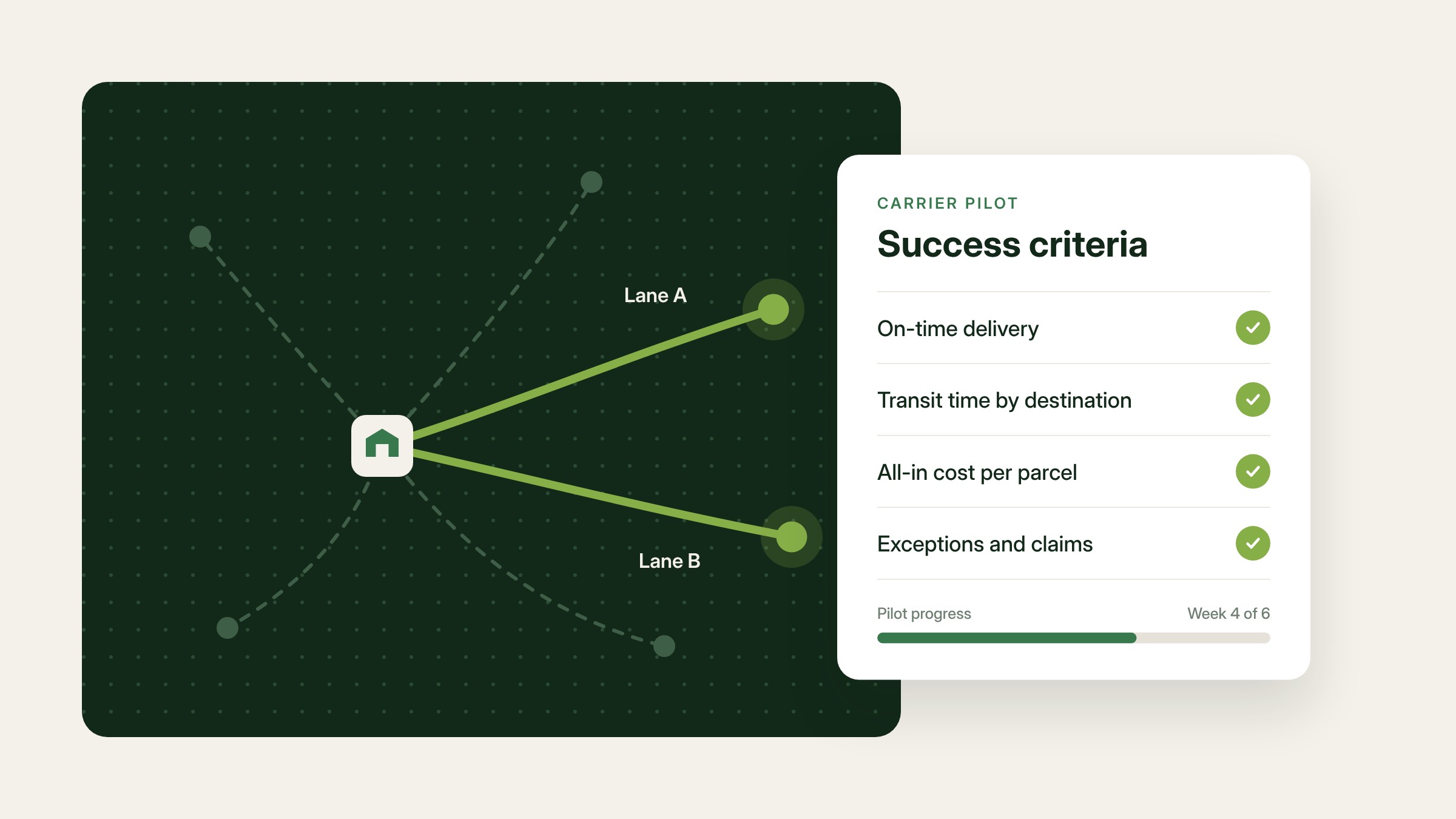
If you're still deciding which carriers to test, start with a structured pilot, and see our guide to building a multi-carrier shipping strategy.
Tusk is shipping infrastructure that connects e-commerce shippers to alternative carriers across all U.S. ZIP codes through a single integration. Unified invoicing puts every carrier's charges in one place, and hub-level performance insights show how each carrier is performing for your volume.
Read the full findings in the 2026 Alternative Carrier Benchmark Report, or talk to Tusk about adding alternative carriers without adding work.